
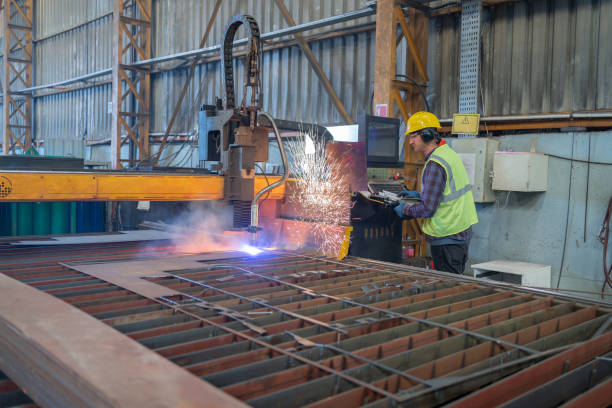

Aluminum casting plants across Alabama are turning to advanced technology to handle the tough job of degating. Cutting off excess gates and risers from cast parts has always been time-consuming and labor-intensive, but new plasma cutter systems are changing that reality. With the precision of automated controls and the support of an Alabama robotics engineering company, foundries are achieving cleaner, faster results that improve both efficiency and quality.
Precision Plasma Cutting Reduces Excess Material During Aluminum Casting Degating
A CNC plasma cutter brings accuracy to the task of separating gates from aluminum castings. Unlike manual torch cutting, which can leave uneven edges, plasma systems apply a controlled arc that reduces the amount of excess material left behind. This means the initial separation is cleaner, leaving less waste to be handled later.
By using advanced motion control and robotics integration, an Alabama robotics engineering company can configure the plasma cutting process to match the shape and thickness of each casting. This approach minimizes errors and ensures that material removal is consistent. In Alabama CNC machining environments, that level of control translates to stronger productivity and less downtime caused by rework.
Cleaner Cut Lines Minimize Finishing Time After Gating Removal
Cleaner separation lines play a direct role in cutting down post-processing. Manual degating often requires extensive grinding or sanding to prepare the casting for finishing. A CNC plasma cutter dramatically reduces the roughness of cut edges, which in turn shortens finishing cycles. Workers can move parts through the production line faster without sacrificing surface quality.
This improvement benefits both small and large foundries engaged in CNC machining in Alabama. Instead of spending hours on hand tools, operators rely on a plasma cutter to deliver near-finished edges. That advantage means castings reach machining centers sooner, accelerating throughput for companies serving automotive, aerospace, and industrial customers.
CNC Accuracy Ensures Repeatable Degating Results Across Production Runs
Consistency across multiple production runs is vital, especially for manufacturers producing high volumes of cast parts. Plasma cutting guided by CNC accuracy provides identical results from one part to the next. Operators can program cutting paths once and then reproduce them for hundreds of parts with no variation.
For facilities working with Alabama CNC machining services, this repeatability improves both cost control and customer satisfaction. The uniformity eliminates guesswork and reduces part rejection rates. A robotics engineering company in Alabama can integrate robotic arms with CNC plasma cutters to automate repetitive tasks, ensuring that each degated casting meets the same precise standards.
Advanced Plasma Systems Improve Safety When Processing Aluminum Castings
Traditional degating methods often rely on manual torches, which expose workers to sparks, fumes, and repetitive strain. Advanced plasma cutters improve safety by placing automation at the center of the process. Operators program and supervise rather than physically cutting gates from hot castings.
This shift is particularly valuable in Alabama casting facilities that process high volumes of aluminum daily. Plasma cutters reduce direct human interaction with molten metal by-products and sharp cast surfaces. With robotic automation from an Alabama robotics engineering company, companies achieve safer workflows while maintaining high productivity.
Consistent Heat Control Prevents Casting Damage During Gate Removal
Aluminum is sensitive to overheating, and excessive heat during degating can cause microfractures or warping. Plasma cutters designed for aluminum casting incorporate advanced heat control, directing energy exactly where it is needed. By maintaining controlled temperatures, they prevent structural damage to the cast part.
This precision heat management is one of the reasons Alabama CNC machining plants prefer plasma solutions. Castings retain their integrity, and the risk of scrap is reduced. Operators benefit from the ability to fine-tune plasma power levels, ensuring that delicate castings are cut cleanly without unnecessary heat stress.
Plasma Cutter Automation Streamlines Complex Degating Patterns
Some castings feature intricate gate designs that can challenge manual cutting methods. Plasma cutter automation handles these patterns with ease, using programmed paths to follow even the most complex shapes. This reduces the need for custom fixtures or specialized tools, saving both time and cost.
By integrating robotics and automation, an Alabama CNC machining provider can configure plasma cutting stations for multiple casting types. This adaptability gives foundries flexibility to handle changing production needs without major equipment adjustments. The result is a smoother workflow that adapts to both small-batch and high-volume orders.
Faster Cycle Times Enhance Overall Productivity in Aluminum Casting Plants
The speed of a CNC plasma cutter directly affects throughput in casting operations. Faster cycle times mean gates are removed in seconds rather than minutes, significantly increasing overall plant output. For companies balancing tight deadlines, this speed advantage helps maintain schedules without compromising quality.
In Alabama, casting plants that adopt CNC plasma solutions see measurable gains in productivity. Faster degating allows more castings to move into machining, finishing, and inspection stages. This advantage supports industries that rely on timely deliveries, from automotive suppliers to aerospace contractors.
Reduced Manual Grinding Improves Quality Control and Surface Finish
Manual grinding is both labor-intensive and inconsistent. Plasma cutting reduces the need for extensive grinding, resulting in smoother edges right after degating. Less time spent with abrasive tools means fewer chances of introducing defects or uneven finishes.
For Alabama CNC machining operations, reduced manual grinding is also a quality control improvement. Castings maintain consistent surface finishes across production runs, ensuring downstream machining processes operate more efficiently. By combining plasma technology with robotics engineering, plants improve both output and part reliability.